The same load that built them last week is breaking them this week.
An average effect hides the one thing a coach most needs — the condition under which it flips its sign.
Two athletes. Same prescription — a hard three-week block, load ramped about 30%. One comes out the far side sharper than they have been all season. The other comes out flat, then sick, then hurt. Run the numbers across your whole roster and the relationship between load and next-week performance is a shrug: a small positive effect, wide error bars, nothing you'd stake a plan on.
That average is true. It is also useless — and quietly misleading. It is the arithmetic mean of two opposite truths, and it describes neither athlete. The block built the first one and broke the second, and the average splits the difference into a number that happened to no one.
An average effect is a lie of composition: it can be positive for everyone, negative for everyone, or — most often — a blend of two regimes the mean was never equipped to tell apart.The problem with one number
01The condition is the coaching
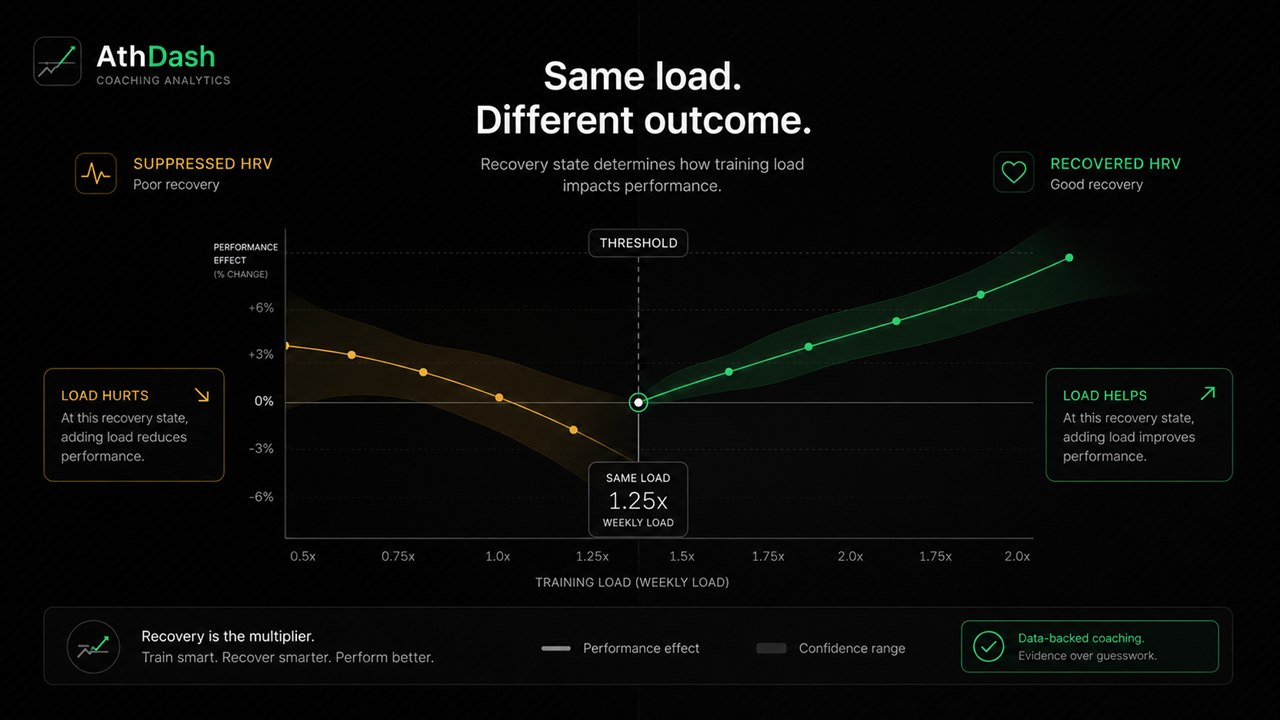
What separated those two athletes wasn't the load. It was the state they were in when it landed. The first athlete absorbed the block on the back of recovered autonomic function — HRV sitting at or above their own baseline. The second took the same load while their HRV was suppressed, already carrying fatigue the prescription didn't know about.
So the honest answer to "does load help?" isn't yes or no. It's: it depends on HRV — and that dependency has a name.
02What an effect modifier is
An effect modifier is a variable that changes the strength — or the sign — of a relationship between two others. Load may relate to performance differently when HRV is recovered versus suppressed. The modifier doesn't cause the outcome itself. It sets the terms under which the cause operates.
Plotted against the modifier, the effect isn't a flat line at its average. It's conditional slope evidence: the estimate can be positive in one observed regime, negative in another, or too uncertain to promote.
03Test the conditional slope; don't assume a cutoff
The trap most tools fall into is hard-coding the breakpoint — a fixed HRV percentage, the same for everyone, borrowed from a population study. AthDash does not need to claim a universal cutoff to be useful; it tests whether the athlete's own data shows conditional slope or sign-change evidence.
That evidence is exploratory unless the athlete has enough events in both regimes. If one side of the condition is thin, the honest output is a lead to test, not a rule to obey.
- Estimate whether the load slope changes across the modifier — not one average slope, but the conditional slope in the observed regimes.
- Look for sign-change evidence, with uncertainty attached, rather than promoting a single crossing point.
- Hold the whole thing to the same gate as any other claim: if either regime is too thin, the modifier remains
insufficientor exploratory, not guessed.
"Should we add load?" stops being a question with one answer. It becomes "which regime is this athlete in, and is the conditional slope licensed enough to act on?"
04Why an AI coach can't skip this
A language model asked "does load improve performance?" will answer fluently in either direction, because both are defensible on the average. That fluency is the danger: it reads the same whether the model has the evidence or is improvising.
Wiring an agent to the conditional effect closes that gap. Instead of one global verdict, the agent gets a finding bound to a condition — and a license that travels with it:
ADVISEwhen the conditional slope evidence is licensed and the interval clears zero — recommend within that regime.HYPOTHESIZEwhen sign-change evidence is plausible but unsettled — surface it as a working hypothesis, don't push.DECLINEwhen the athlete sits in a regime the data hasn't covered — say nothing yet.
The agent never has to bluff a single answer to a question that has two, because the question was never single to begin with.
05What we actually ship
Not "load helps performance (p<.05)." That sentence is the thing we're arguing against. What leaves the engine is closer to:
Load's effect on the next benchmark depends on HRV — about−0.056when HRV is suppressed, flipping to+0.022when it's recovered. An exploratory modifier estimated from 19 athlete-days — surfaced, not yet confirmed.A claim with its conditions attached
It's a longer sentence than a readiness score. It's also the difference between a number a coach can defend to an athlete and a number that, three weeks from now, quietly broke one of them.
- effect modifier
- A condition that may change a relationship's strength or sign. AthDash tests the condition before promoting the modifier.
- within-athlete
- Worked out inside one athlete's own history — not borrowed from a cohort they may not resemble.
- confidence interval
- The range the true effect plausibly sits in. We ship it, never a bare number.
- license
- How far an AI coach is allowed to act on a finding,
DECLINE→ACT.